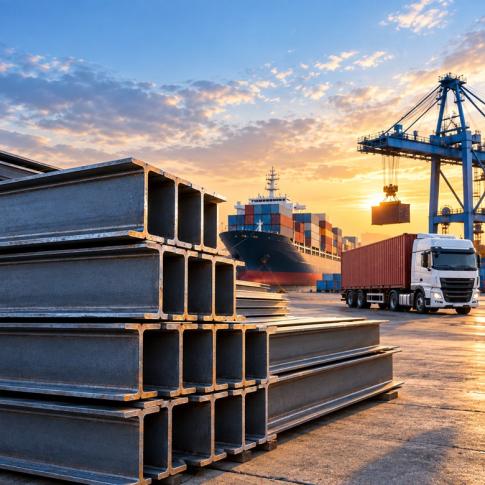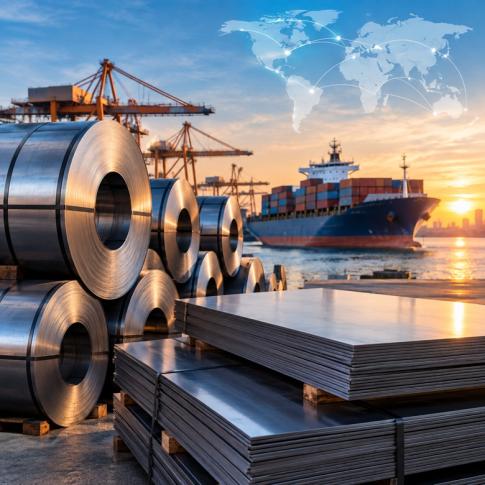
Steel sheets are used in various industries, including construction, automotive manufacturing, pipe and profile production, industrial equipment, tanks, oil and gas industries, and machinery manufacturing. Therefore, steel sheet exports are not limited to a single product, and depending on the requirements of the destination market, various types of hot rolled steel sheets, cold rolled steel sheets, galvanized steel sheets, pre-painted steel sheets, and other flat steel products can be supplied and exported.
Steel Sheet Export from Iran is an important part of the steel products trade in the region. The diversity of steel products, access to raw materials, domestic production capacity, and Iran's geographical location have made Iranian steel sheets attractive to buyers and importers in various markets.
Steel sheets are used in various industries, including construction, automotive manufacturing, pipe and profile production, industrial equipment, tanks, oil and gas industries, and machinery manufacturing. Therefore, steel sheet exports are not limited to a single product, and depending on the requirements of the destination market, various types of hot rolled steel sheets, cold rolled steel sheets, galvanized steel sheets, pre-painted steel sheets, and other flat steel products can be supplied and exported.
For information about the most important aspects of steel sheet exports from Iran, exportable steel sheet types, technical specifications, standards, packaging, transportation, pricing, and target markets, contact our experts.
Steel sheet is one of the most important flat steel products and is manufactured in various dimensions, thicknesses, grades, and standards.
In the steel sheet export process, the product price is not the only determining factor. International buyers generally consider a range of factors such as steel grade, thickness, width, length, production standard, surface quality, coil or bundle weight, packaging type, delivery terms, and technical documentation.
Therefore, export steel sheets should be supplied according to the buyer's exact order specifications.
For example, one buyer may require hot rolled steel sheet with a specific grade and a thickness of 5 mm, while another buyer may need galvanized steel sheet with a lower thickness and a specific zinc coating for industrial components.
Therefore, successful steel sheet export from Iran begins with a clear understanding of the buyer's exact requirements.
Depending on supply capacity and the requirements of the destination market, different types of steel sheets can be supplied for export.
Hot rolled steel sheet is one of the most widely used steel products in the export market.
This product is manufactured through the hot rolling process and is generally used in applications where dimensional accuracy and surface quality are not the primary requirements compared with cold rolled steel products.
Common applications of hot rolled steel sheet include:
Some hot rolled steel products are classified under Chapter 72 of the Harmonized System, while the exact HS Code depends on the product specifications, width, thickness, alloy composition, and form of supply. Therefore, the HS Code should be determined based on the actual specifications of the product rather than simply using the general term "steel sheet." Volza
Cold rolled steel sheet is produced through the further rolling of hot rolled steel and generally offers a smoother surface, better visual quality, and higher dimensional accuracy.
This product is used in industries such as:
It is widely used in these applications.
Galvanized steel sheet is coated with zinc, providing greater resistance to corrosion and making it suitable for many construction and industrial applications.
Common applications include:
These are among the common applications of galvanized steel sheet.
In international trade, galvanized steel sheets are also classified under different tariff groups, and specifications such as coating type and thickness are important factors in determining the exact HS Code. Volza
Pre-painted steel sheet is generally manufactured based on galvanized steel sheet and is coated with paint to provide both suitable resistance and an attractive appearance.
This type of steel sheet is used in:
It is commonly used in these applications.
One of the most important stages in purchasing and exporting steel sheets is accurately defining the technical specifications of the product.
International buyers generally specify the following information in their purchase requests:
| Specification | Description |
|---|---|
| Sheet Type | Hot rolled, cold rolled, galvanized, pre-painted, etc. |
| Thickness | Measured in millimeters |
| Width | Measured in millimeters |
| Length | For cut-to-length sheets |
| Grade | Product grade |
| Standard | ASTM, EN, DIN, JIS, etc. |
| Weight | Weight of each coil or bundle |
| Form of Supply | Coil or Sheet |
| Coating | For coated products |
| Dimensional Tolerance | According to the agreed standard |
For professional export transactions, the product specifications should be clearly determined before the final price is quoted.
Different markets may accept different standards for steel products.
Common standards include:
The appropriate standard depends on the destination country, the intended application, and the buyer's technical requirements.
In export orders, providing a Mill Test Certificate (MTC) can also provide the buyer with important information regarding the chemical composition and mechanical properties of the product.
Steel products may be supplied as Coils or Cut-to-Length Sheets.
The choice between these two forms depends on the customer's final application.
Coils are suitable for many manufacturers, rolling companies, and factories that perform cutting or forming processes at the destination.
Cut-to-length sheets are suitable for customers who use the product directly in manufacturing or construction processes.
Therefore, when receiving an export order, it is important to determine exactly which form and dimensions of the product the customer requires.
Proper packaging is an important part of exporting steel products.
Steel sheets should be packaged in a way that minimizes the risk of damage during sea, road, or multimodal transportation.
The packaging method depends on the product, but factors such as:
can help maintain product quality and facilitate cargo inspection and handling.
The choice of transportation method depends on the destination, shipment volume, cargo weight, and contractual terms.
For large-volume orders and exports to more distant countries, sea transportation is generally an important option.
For nearby markets, road transportation can be a suitable option, particularly for neighboring countries and regional markets.
In some transactions, a combination of road, rail, and sea transportation can also be used.
The transportation method should be selected while considering cost, delivery time, destination port or border, and the terms of the sales contract.
In general, the steel sheet export process can be summarized in the following main stages:
1. Receiving the Order Specifications
The sheet type, grade, thickness, width, quantity, and destination are determined.
2. Checking Supply Availability
Available stock, suitable mills or suppliers, and production conditions are reviewed.
3. Calculating the Export Price
The product price, packaging, domestic transportation, export-related costs, and international freight are considered in the calculation.
4. Commercial Agreement with the Buyer
The price, quantity, payment terms, delivery schedule, and Incoterm are agreed upon.
5. Preparing the Goods and Documents
The products are prepared according to the order specifications, and the required commercial and technical documents are arranged.
6. Completing Export Customs Procedures
The required customs procedures and legal requirements related to the product are completed.
7. Transportation to the Destination
The shipment is transported to the designated border, port, or destination according to the agreed terms.
Iran's regulations regarding steel product exports may change depending on market conditions, trade policies, and decisions made by the relevant authorities.
For example, in 2026, restrictions were imposed on the export of certain steel products, and in June 2026, restrictions on the export of slabs and certain types of steel sheets were lifted. Iran Localize
In addition, hot rolled steel sheet exports are subject to regulations concerning supply through the export ring of the Iran Mercantile Exchange and the submission of a purchase certificate. Tasnim News
Therefore, before any export transaction, the latest regulations and requirements applicable to the specific product type and its tariff code should be verified.
The HS Code, or Harmonized System tariff code, is used to identify goods in international trade.
Steel sheets may be classified under different tariff codes depending on factors such as:
Therefore, they may fall under different tariff codes.
For this reason, there is no single HS Code applicable to all types of steel sheets. Available trade data also shows different codes for hot rolled, galvanized, and other steel sheets. Volza
The export price of steel sheets depends on various factors.
The most important factors include:
Therefore, it is not possible to provide a fixed export price for steel sheets without knowing the exact product specifications.
To receive an accurate quotation, the buyer should provide the required technical specifications and quantity so that the price can be calculated based on the order and final destination.
Iran's geographical location provides access to a wide range of regional markets.
Depending on the type of steel sheet, competitive pricing, transportation conditions, and the requirements of the destination country, markets such as:
can be considered as potential export destinations.
However, the selection of a target market should be based on actual market demand, import tariffs, accepted standards, transportation costs, competitors, and the regulations of the destination country.
In steel transactions, simply finding a seller offering a low price is not enough.
The supplier or trading company must be able to provide a product that exactly matches the customer's order specifications.
Even a difference of a few tenths of a millimeter in thickness, a change in grade, a difference in standard, or an incorrect coating can create problems for an industrial buyer.
Therefore, in steel sheet exports, reliable supply and accurate product specification control are just as important as price.
Tisa Tamin focuses on the supply and trading of steel products and provides the possibility of sourcing various steel sheets according to the requirements of domestic and international buyers.
For export orders, product specifications are reviewed according to the customer's requirements, with factors such as sheet type, grade, dimensions, quantity, packaging conditions, destination, and transportation method taken into consideration throughout the sourcing process.
Tisa Tamin's goal is to establish a reliable route for steel sheet sourcing, export process coordination, and delivery of products according to the agreed order specifications.
If you require pricing and supply conditions for purchasing or exporting steel sheets, you can submit your required product specifications to Tisa Tamin so that the availability and export conditions can be evaluated.
Regional markets such as Iraq, Turkey, Afghanistan, Central Asian countries, and Gulf countries can be considered among the potential destinations for Iranian steel sheet exports. The appropriate destination depends on the product type, price, standards, and import requirements of the destination country.
Depending on supply conditions, hot rolled steel sheets, cold rolled steel sheets, galvanized steel sheets, pre-painted steel sheets, and other flat steel products can be supplied for export.
The sheet type, grade, thickness, width, required quantity, form of supply, destination, and, if available, the required standard should be specified.
Yes. Many steel sheet products can be supplied as coils or cut-to-length sheets, and the appropriate form depends on the customer's requirements and final application.
Steel sheets do not have a single HS Code. The exact code is determined based on the type of steel, production process, coating, width, thickness, and other product specifications.
Conclusion
Steel sheet export from Iran is a specialized process that begins with product selection and reliable sourcing and continues through specification control, packaging, documentation, export customs procedures, and transportation to the destination.
For a successful transaction, a competitive price should be combined with quality, accurate technical specifications, reliable supply, appropriate packaging, and knowledge of export regulations.
Tisa Tamin can cooperate with buyers by reviewing their order specifications and supporting the sourcing and export of steel sheets according to their requirements.

Tisa Trading Group, with a history of more than 10 years, is one of the largest suppliers of graphite electrodes for the steelmaking industry in the country. This company, relying on foreign investment, has provided various types of graphite electrodes in the sizes required by Iranian industries.
Copyright © Tisa Tamin 2025. All rights reserved.
 فا
فا
 Ar
Ar