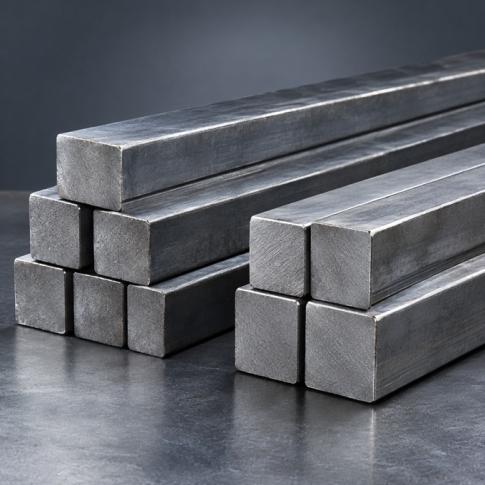
One of the most important factors when purchasing steel billets is their grade and chemical composition. Steel billets serve as the raw material for manufacturing products such as reinforcing bars, wire rod, angles, channels, and other steel sections, playing a significant role in the quality and performance of the final product. Therefore, the appropriate billet grade should be selected according to the intended product, rolling conditions, and technical requirements.
In the Iranian steel market, 3SP and 5SP steel billets are well-known grades widely considered by buyers and steel section manufacturers. The main differences between these grades are related to their carbon content, the ranges of certain alloying elements, and the resulting differences in the mechanical properties of the steel.
Due to its lower carbon content, 3SP billet is generally considered for applications where formability and deformation capability are important. In contrast, 5SP billet, with its higher carbon content, may be suitable for manufacturing products that require different mechanical properties. However, the final selection depends on the applicable product standard and the results of technical tests.
In this article from Tisa Tamin, we examine the chemical analysis of 3SP and 5SP billets, the differences between these two grades, their common applications, and the factors affecting steel billet prices and purchasing decisions.
3SP steel billet is a carbon steel grade used in the production of steel sections through hot rolling. This grade corresponds to St3sp in the GOST standard designation system, and its chemical composition is determined according to the requirements of the applicable standard.
The letters and numbers used in this grade designation provide information about the steel category and its deoxidation condition. In the Russian designation system, the number 3 identifies the steel grade, while SP refers to fully killed steel, which has been deoxidized during steelmaking.
The main characteristics of 3SP billet include:
Lower carbon content compared with 5SP steel
Suitable deformation characteristics under processing conditions appropriate for the grade
Use in the production of various structural steel sections
Suitability for hot-rolling lines, provided that the billet specifications meet the production requirements
The importance of controlling chemical composition and surface quality to achieve a satisfactory final product
However, properties such as strength, formability, and weldability are not determined by the grade designation alone. Billet dimensions, manufacturing quality, rolling conditions, any subsequent heat treatment, and the final product standard also affect performance.
The chemical analysis of 3SP billet is one of the most important criteria for evaluating its quality and suitability for a manufacturing process. This analysis examines the percentages of the chemical elements present in the steel to determine whether the product complies with the standard limits and the specifications agreed upon with the buyer.
The following table presents the typical ranges for the main elements in St3sp steel according to GOST 380-2005.
| Chemical Element | Symbol | Range or Permissible Limit |
|---|---|---|
| Carbon | C | 0.14–0.22% |
| Manganese | Mn | 0.40–0.65% |
| Silicon | Si | 0.15–0.30% |
| Phosphorus | P | Maximum 0.05% |
| Sulfur | S | Maximum 0.05% |
Source: GOST 380-2005, chemical composition requirements for St3sp steel. The values above should be verified against the applicable edition of the standard and the technical specifications stated in the purchase contract.
Carbon is one of the key elements influencing steel properties. Its content affects strength, hardness, and formability. Manganese also contributes to certain mechanical properties and influences steel behavior. Silicon plays a role in steel deoxidation, while phosphorus and sulfur must be maintained within the permitted limits because excessive amounts can adversely affect steel performance.
An important consideration when purchasing 3SP billet is that the values in the table represent standard limits and do not necessarily indicate the actual elemental composition of every shipment. For an accurate assessment, buyers should obtain the chemical analysis report for the specific heat from the supplier.
5SP steel billet is another carbon steel grade used in the rolling industry. Under the GOST designation system, it corresponds to St5sp steel.
The most important difference between this grade and 3SP is its higher carbon content. This difference in chemical composition can affect the strength, hardness, and formability of the steel. Therefore, 5SP billet is not a direct substitute for 3SP billet in every production line or application.
The notable characteristics of 5SP billet include:
Higher carbon content compared with 3SP steel
Potential differences in mechanical properties compared with 3SP
Use in the production of certain steel sections, depending on the applicable standard and required specifications
The need for a more detailed assessment of rolling conditions and final product requirements
The importance of obtaining a reliable chemical analysis report for shipment quality control
The selection of 5SP billet should be based on the final product specifications, the capabilities of the rolling line, and the applicable production standard. A higher carbon content alone does not mean that this grade is more suitable for every application.
Reviewing the chemical analysis of 5SP billet helps buyers compare the product's chemical composition with their technical requirements. In St5sp steel, the carbon content is higher than in St3sp, and the manganese range is also different.
The typical ranges for the main elements in 5SP steel billet according to GOST 380-2005 are as follows:
| Chemical Element | Symbol | Range or Permissible Limit |
|---|---|---|
| Carbon | C | 0.28–0.37% |
| Manganese | Mn | 0.50–0.80% |
| Silicon | Si | 0.15–0.30% |
| Phosphorus | P | Maximum 0.05% |
| Sulfur | S | Maximum 0.05% |
Source: GOST 380-2005, chemical composition requirements for St5sp steel. The actual values for each shipment should be verified using the manufacturer's material analysis certificate.
Based on this chemical composition, 5SP billet contains more carbon than 3SP billet. This difference can influence steel behavior during rolling and affect the mechanical properties of the final product.
When purchasing 5SP billet, buyers should examine manganese, silicon, phosphorus, and sulfur levels in addition to carbon content. It is also important to verify that the product specifications comply with the purchasing factory's requirements, since the grade designation alone does not guarantee identical quality across all shipments available on the market.
The main difference between 3SP and 5SP steel billets lies in their chemical composition, particularly their carbon content. This difference can result in variations in mechanical properties and steel behavior during forming processes.
The following table summarizes the key differences between these two grades.
| Comparison Criteria | 3SP Steel Billet | 5SP Steel Billet |
|---|---|---|
| Corresponding Standard Designation | St3sp | St5sp |
| Carbon Content | 0.14–0.22% | 0.28–0.37% |
| Manganese Content | 0.40–0.65% | 0.50–0.80% |
| Silicon Range | 0.15–0.30% | 0.15–0.30% |
| Potential Effect of Composition on Properties | Lower carbon content and potentially better formability, depending on processing conditions | Higher carbon content and the potential for different mechanical properties |
| Application Selection | Based on product and rolling line requirements | Based on product and rolling line requirements |
| Main Purchasing Criteria | Chemical analysis, standard compliance, and shipment quality | Chemical analysis, standard compliance, and shipment quality |
The chemical values in the table are based on the specified ranges for the corresponding grades under GOST 380-2005. Final mechanical properties cannot be determined conclusively from this table alone.
Carbon is the most important chemical element when comparing these two grades. The carbon range in 5SP billet is higher than that in 3SP, which can affect steel hardness, strength, and formability.
When selecting a grade, it is important to remember that higher carbon content is not always an advantage. If the final product requires greater formability or specific welding characteristics, the grade should be selected carefully according to the technical specifications.
Differences in chemical composition can lead to variations in mechanical properties. However, tensile strength, yield strength, elongation, and toughness also depend on other factors, including manufacturing conditions, rolling temperature, and the requirements of the applicable product standard.
For this reason, an accurate comparison of the mechanical properties of two billet shipments requires a review of their test certificates and valid laboratory test results.
Both grades can be used in the production chain for steel sections. However, the choice between them should depend on the final product type and the requirements of the production line.
For example, a manufacturer that requires a specific level of formability during rolling should select a grade that meets the production requirements and the applicable product standard. If different mechanical properties are required, 5SP billet may also be considered as part of the technical evaluation.
The prices of 3SP and 5SP billets are not necessarily the same. However, without examining market conditions and shipment specifications, it is not possible to conclude that one grade is always cheaper than the other.
The final price depends on factors such as current steel market prices, the manufacturer, order volume, billet dimensions, quality and chemical analysis, delivery terms, and transportation costs.
Therefore, a valid price comparison between the two grades requires comparable technical specifications and transaction conditions.
The answer depends on the intended application. Neither grade can be considered the better option for every buyer without understanding the product specifications and manufacturing process.
If formability and compatibility with the manufacturing process are important, evaluating 3SP billet may be a suitable starting point. If the product requires different mechanical properties, 5SP billet should also be assessed against the relevant standard.
To make an appropriate selection, the following factors should be established before placing an order:
The type of final product, such as reinforcing bars, wire rod, or other steel sections
The applicable standard for the final product
The required chemical composition range
Mechanical requirements and expected test results
Billet dimensions and rolling line capacity
Surface quality and defect inspection requirements
Delivery terms, order tonnage, and supply schedule
This assessment helps manufacturers select a grade based on their actual production requirements and reduces the risk of manufacturing problems or non-compliance in the final product.
Steel billets are important raw materials for manufacturing long steel products. Depending on their chemical composition and production requirements, 3SP and 5SP billets can also be used in certain rolling processes.
3SP billet may be used to manufacture the following products, provided that the applicable standards and the required mechanical properties of the final product are met:
Various types of construction reinforcing bars
Wire rod and certain rolled steel products
Certain structural steel sections
Steel products requiring formability compatible with the properties of this grade
5SP billet is also used in certain steel section production lines. Its selection should be based on the required product specifications and the capabilities of the rolling line. Potential applications include:
Manufacturing certain structural steel sections
Producing certain long steel products
Rolling applications in which the chemical and mechanical properties of 5SP meet the relevant production requirements
Important note: The suitability of a grade for producing reinforcing bars, wire rod, or other sections does not mean that it is appropriate for every type or classification of those products. The final product standard and test results should guide the decision.
Steel billet prices are among the most important factors influencing purchasing decisions for bulk buyers and steel section manufacturers. However, when comparing the price of 3SP billet or 5SP billet, buyers should consider not only current market rates but also technical specifications and order conditions.
The main factors affecting steel billet prices include:
Billet prices fluctuate in response to supply and demand, raw material costs, production levels at steel mills, and overall steel market conditions. Therefore, buyers should check current prices and the validity period of each quotation before making a purchasing decision.
The steel grade and its compliance with the required technical specifications can affect the transaction price. 3SP and 5SP billets should be compared based on their actual chemical analysis and contractual requirements, rather than on the grade designation alone.
The steel mill, consistency of quality, production process control, and reliability of technical certificates are important factors when evaluating purchasing offers.
Cross-sectional dimensions, billet length, and the weight of each piece affect how the product is used in the rolling line, as well as transportation and related costs. For this reason, buyers should provide accurate dimensional specifications when requesting a quotation.
Order volume, delivery location, transportation costs, loading schedule, and payment terms can all affect the final cost of steel billet procurement.
Supply and demand conditions, as well as available stock, may change over time. Therefore, each quotation should be evaluated together with its validity period, available tonnage, and delivery terms.
For an accurate comparison of suppliers' offers, it is advisable to obtain the same information from each supplier:
Billet grade and applicable standard
Chemical analysis certificate
Steel mill or manufacturer
Dimensions and weight
Available delivery tonnage
Price per kilogram or metric ton
Delivery terms and location
Transportation and any other applicable costs
This approach enables a more meaningful comparison of prices and helps buyers avoid making decisions based solely on the lowest quoted rate.
Purchasing steel billets for factories, rolling mills, and steel traders requires a simultaneous assessment of price, quality, and technical specifications. Selecting an unsuitable grade may lead to increased scrap, production difficulties, or failure of the final product to meet the required standard.
The following steps can help buyers make more informed decisions when purchasing 3SP steel billets or 5SP billets.
The first step is to determine which billet grade is required for the final product. This decision should be based on the product standard, expected mechanical properties, and rolling line requirements.
The chemical analysis report or mill test certificate provides information about the elemental composition and the product's compliance with the order specifications. Mechanical test results should also be requested when required.
Billet dimensions, cross-sectional uniformity, surface condition, and the presence of visible defects are important quality assessment criteria. These characteristics should be checked according to the buyer's technical requirements.
Once the technical specifications have been verified, steel billet prices can be compared in terms of unit price, tonnage, delivery schedule, and additional costs.
The grade, applicable standard, chemical composition limits, dimensions, tonnage, delivery terms, and quality control requirements should be clearly stated in the purchase order or contract. This helps prevent disputes regarding product specifications at the time of delivery.
The trade name or grade stated on a pro forma invoice is not sufficient on its own to verify billet quality. Two shipments carrying the same grade designation may differ in their actual elemental composition, surface quality, production consistency, or technical test results.
Reviewing the chemical analysis helps buyers to:
Assess whether the chemical composition complies with the specified standard
Gain greater confidence that the grade is suitable for the intended manufacturing process
Compare suppliers' offers using consistent specifications
Reduce the risk of purchasing non-conforming products
Obtain the technical documentation required for quality control of the final product
For these reasons, obtaining a reliable chemical analysis certificate and reviewing it alongside the purchase specifications are essential steps when buying 3SP or 5SP steel billets.
3SP and 5SP steel billets are well-known carbon steel grades whose main differences lie in their chemical composition, particularly their carbon and manganese content. These differences can influence mechanical properties and steel behavior during rolling.
With its lower carbon content, 3SP billet may be considered for applications where formability consistent with the grade's specifications is important. 5SP billet, with its higher carbon content, may be selected for applications whose requirements are compatible with its expected properties. However, neither grade can be considered universally more suitable without assessing the applicable standard and manufacturing requirements.
Furthermore, the prices of 3SP and 5SP billets are not determined by grade alone. Factors such as the manufacturer, product quality, dimensions, order tonnage, and delivery terms also affect the final cost.
Tisa Tamin focuses on steel product supply and can assist buyers in reviewing technical specifications and comparing purchasing options. To identify a suitable grade, it is advisable to specify your final product, required tonnage, and technical requirements so that available supply options can be evaluated based on more precise information.

Tisa Trading Group, with a history of more than 10 years, is one of the largest suppliers of graphite electrodes for the steelmaking industry in the country. This company, relying on foreign investment, has provided various types of graphite electrodes in the sizes required by Iranian industries.
Copyright © Tisa Tamin 2025. All rights reserved.
 فا
فا
 Ar
Ar